
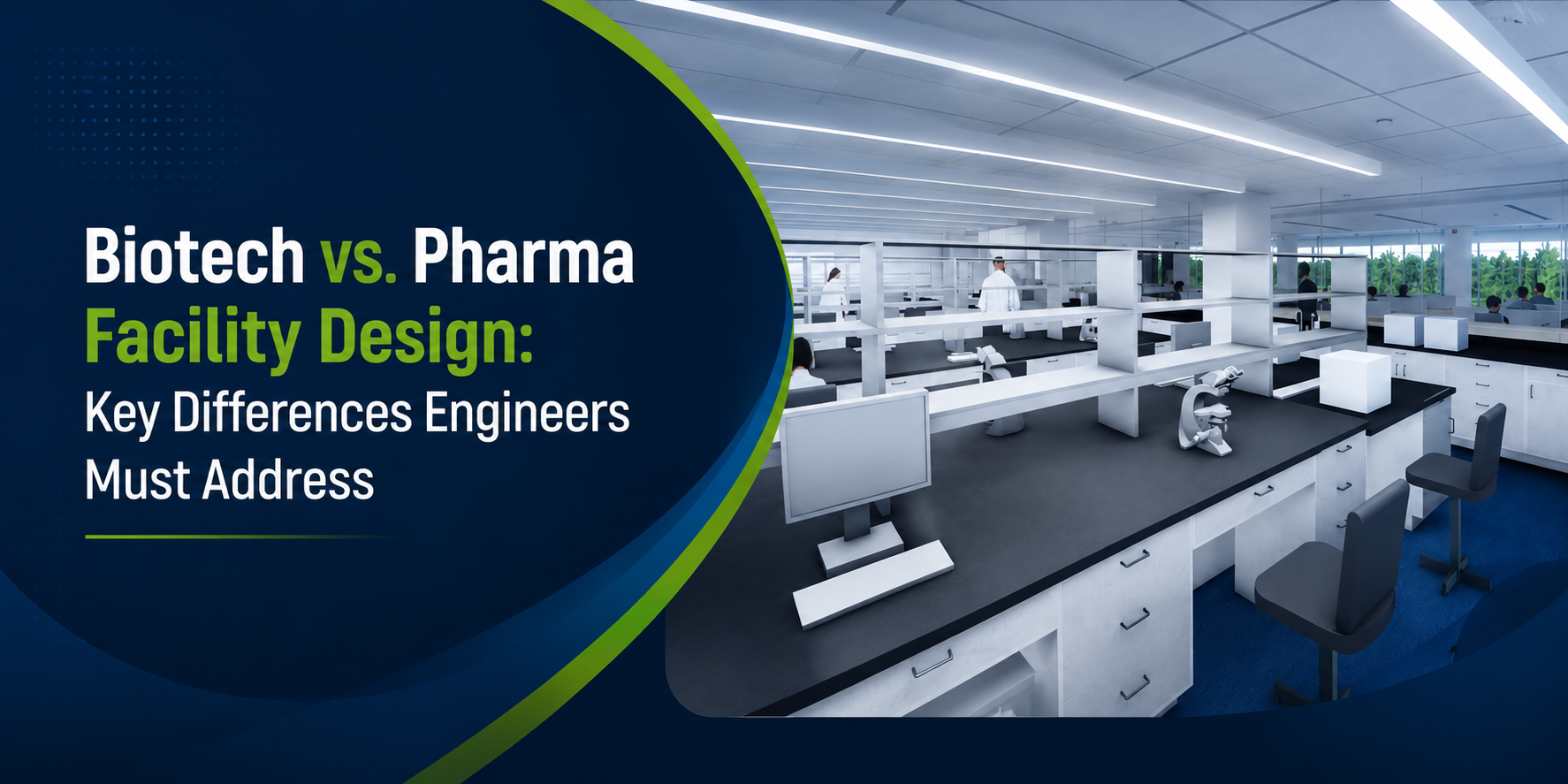
At first glance, biotech and pharmaceutical facilities can look similar, both are highly regulated, both demand precision engineering, and both exist to produce products that keep people healthy. But scratch the surface and the differences in design intent, process complexity, and regulatory expectations become clear. For engineers and facility planners working on biotechnology projects, understanding these distinctions isn't optional, it's the foundation of a facility that performs safely, efficiently, and compliantly from day one.
Whether you're scaling up a cell therapy manufacturing suite or designing a solid-dose pharma plant, the decisions made at the design stage ripple through construction, validation, and years of operation. Here's what engineers need to know.
1. Process Complexity and Facility Flexibility
Pharmaceutical manufacturing, particularly for small-molecule drugs, tends to follow well-established, repeatable processes, synthesis, formulation, tableting, coating, and packaging. Facilities can be designed around fixed, linear process flows because the chemistry is predictable and the equipment footprint is largely standardized.
Biotech facilities, on the other hand, work with living systems, cell cultures, microbial fermentation, gene and cell therapies. These processes are inherently more variable, sensitive to environmental fluctuations, and often still evolving even after the facility is built. This is why biotechnology projects increasingly favor modular, flexible designs, single-use bioprocessing systems, mobile skids, and ballroom-style suites that can be reconfigured as the science and product pipeline change.
2. Containment and Contamination Control
Both facility types demand strict contamination control, but the nature of the risk differs.
Pharma facilities primarily manage particulate and chemical cross-contamination, especially in multi-product plants where potent compounds require containment (OEB-based classifications, isolators, and airlocks).
Biotech facilities must additionally address biological contamination, preventing microbial ingress, cross-contamination between cell lines, and in some cases, containment of genetically modified organisms (GMOs) or viral vectors.
This changes everything from HVAC design to gowning protocols. Biotech facilities often require unidirectional personnel and material flow, dedicated air handling units per suite to prevent cross-contamination between processes, and specialized biosafety cabinets or BSL-rated spaces for certain applications.
3. HVAC and Environmental Control
HVAC design is where the two disciplines diverge sharply.
Pharma cleanrooms are typically classified under ISO 14644 or EU GMP Grades A–D, with environmental parameters focused on particulate control and, in sterile manufacturing, microbial control during aseptic filling.
Biotech facilities layer on additional demands: tighter humidity and temperature tolerances to protect live cultures, higher air change rates in critical zones, and segregation strategies to prevent one bioprocess from contaminating another. Single-pass air systems are common in biotech to avoid recirculating potentially contaminated air between suites, a costlier but often necessary design choice.
4. Utility and Process Support Systems
Biotech manufacturing is utility-intensive in specific ways:
- High-purity water systems (WFI, USP Purified Water) sized for buffer and media preparation
- Clean steam for autoclaves and SIP (steam-in-place) systems
- Extensive use of single-use technology, which shifts capital investment from fixed stainless-steel systems toward flexible bag-based systems, with corresponding waste and logistics planning
- Cold chain infrastructure for temperature-sensitive raw materials and products, especially in cell and gene therapy
Pharma facilities also need robust utilities, but often at a different scale and with more standardized, long-life equipment given the more predictable, high-volume nature of production.
5. Regulatory and Validation Pathways
Both industries fall under GMP, but the regulatory lens differs. Pharma facilities are evaluated heavily against established compendial standards and process validation frameworks refined over decades. Biotech facilities, especially those producing biologics, cell and gene therapies, or novel modalities, often navigate less standardized regulatory pathways, requiring closer collaboration with agencies during design and commissioning.
This means biotech facility design must build in flexibility for evolving regulatory guidance, while pharma facilities can lean on more mature, predictable compliance frameworks.
6. Scale-Up Considerations
Pharma facilities are frequently designed for immediate, defined production volumes. Biotech projects, particularly in emerging modalities, are often designed with scale-up, or even scale-out, in mind, since clinical-stage processes may need to expand rapidly once a therapy advances through trials. This drives decisions around shell space, utility oversizing, and modular suite design that a facility built purely for pharma production might not require.
Why the Right Design Partner Matters
Because biotech and pharma facilities diverge in process flow, containment strategy, HVAC philosophy, and regulatory approach, engineering teams benefit enormously from partnering with a pharma design consultant who understands both worlds, not just one. A consultant fluent only in traditional pharma manufacturing may default to rigid, over-standardized designs that don't serve the flexibility biotech processes demand. Conversely, a purely biotech-focused approach might underdeliver on the throughput optimization pharma manufacturing requires.
The most successful biotechnology projects are the ones where engineers, architects, and process consultants collaborate early, aligning facility design with the specific biological or chemical processes involved, the regulatory pathway, and the company's growth trajectory.
Final Thoughts
Biotech and pharma facilities may share a regulatory neighborhood, but their engineering DNA is distinct. From HVAC segregation strategies to utility planning and process flexibility, the details matter, and getting them wrong can mean costly retrofits or compliance setbacks down the line. For engineers leading biotechnology projects, the goal isn't to copy a pharma playbook, but to design purpose-built facilities that respect the unique demands of biological manufacturing while still meeting the rigor of GMP compliance.